Saturday, 13 Dec 2025
Subscribe
logo
  • Global
  • AI
  • Cloud Computing
  • Edge Computing
  • Security
  • Investment
  • Sustainability
  • More
    • Colocation
    • Quantum Computing
    • Regulation & Policy
    • Infrastructure
    • Power & Cooling
    • Design
    • Innovations
    • Blog
Font ResizerAa
Data Center NewsData Center News
Search
  • Global
  • AI
  • Cloud Computing
  • Edge Computing
  • Security
  • Investment
  • Sustainability
  • More
    • Colocation
    • Quantum Computing
    • Regulation & Policy
    • Infrastructure
    • Power & Cooling
    • Design
    • Innovations
    • Blog
Have an existing account? Sign In
Follow US
© 2022 Foxiz News Network. Ruby Design Company. All Rights Reserved.
Data Center News > Blog > Quantum Computing > Scientists created the first programmable, logical quantum processor
Quantum Computing

Scientists created the first programmable, logical quantum processor

Last updated: January 22, 2024 5:36 am
Published January 22, 2024
Share
Scientists created the first programmable, logical quantum processor
SHARE

The primary challenge for practical quantum computing is error suppression, necessitating quantum error correction for extensive processing. However, implementing error-corrected “logical” qubits, where information is redundantly encoded across multiple physical qubits, presents significant challenges for achieving large-scale logical quantum computing.

A new study by Harvard scientists reports realizing a programmable quantum processor based on encoded logical qubits operating with up to 280 physical qubits. This is a critical milestone in the quest for stable, scalable quantum computing.

This new quantum processor can encode up to 48 logical qubits and execute hundreds of logical gate operations, a vast improvement over prior efforts. This system marks the initial showcase of running large-scale algorithms on an error-corrected quantum computer, signaling the arrival of early fault-tolerant quantum computation that operates reliably without interruption.

Denise Caldwell of the National Science Foundation said, “This breakthrough is a tour de force of quantum engineering and design. The team has not only accelerated the development of quantum information processing by using neutral atoms but opened a new door to explorations of large-scale logical qubit devices, which could enable transformative benefits for science and society as a whole.”

A quantum bit or qubit is one unit of information in quantum computing. In the world of quantum computing, in principle, it is possible to create physical qubits by manipulating quantum particles — be they atoms, ions, or photons.

Harnessing the peculiarities of quantum mechanics for computation is more intricate than merely accumulating a sufficient number of qubits. Qubits are inherently unstable and susceptible to collapsing out of their quantum states.

See also  Data Center Logical Security Market to See Incredible Growth 2024-2031 |Cisco, Mcafee, HP

The accurate measure of success lies in logical qubits, known as the “coins of the realm.” These are bundles of redundant, error-corrected physical qubits capable of storing information for quantum algorithms. Creating controllable logical qubits, akin to classical bits poses a significant challenge for the field. It is widely acknowledged that until quantum computers can operate reliably on logical qubits, the technology cannot truly advance.

Current computing systems have demonstrated only one or two logical qubits and a single quantum gate operation—a unit of code—between them.

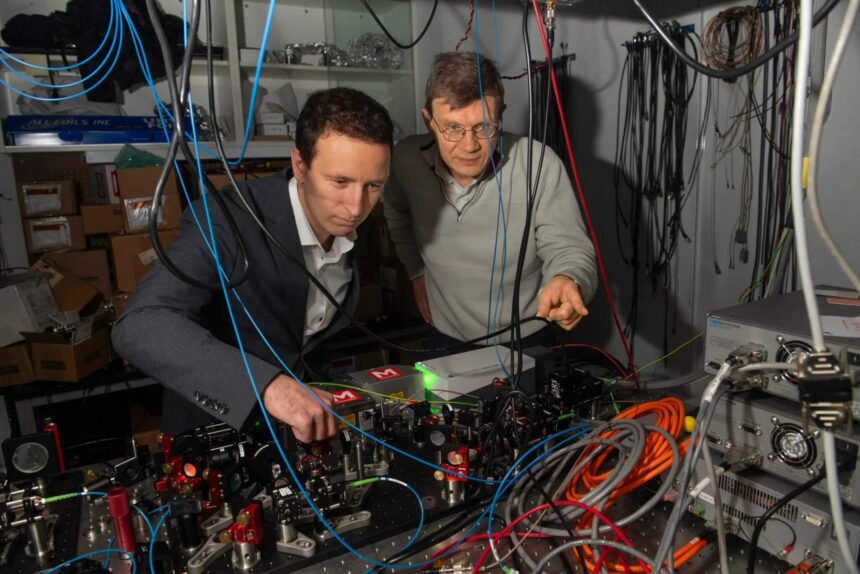
The breakthrough by the Harvard team is built upon years of research on a quantum computing architecture called a neutral atom array, pioneered in Lukin’s lab. QuEra, a company commercializing this technology, recently entered into a licensing agreement with Harvard’s Office of Technology Development for a patent portfolio based on Lukin’s group’s innovations.

A block of ultra-cold, suspended rubidium atoms is at the heart of the system. These atoms, serving as the system’s physical qubits, can move around and form pairs or become “entangled” during computations.

Entangled pairs of atoms come together to form gates, representing units of computing power. The team had previously showcased low error rates in their entangling operations, establishing the reliability of their neutral atom array system.

In their logical quantum processor, the scientists have now demonstrated parallel, multiplexed control over an entire section of logical qubits using lasers. This approach is more efficient and scalable compared to individually controlling physical qubits.

Paper first author Dolev Bluvstein, a Griffin School of Arts and Sciences Ph.D. student in Lukin’s lab, said, “We are trying to mark a transition in the field, toward starting to test algorithms with error-corrected qubits instead of physical ones, and enabling a path toward larger devices.”

Journal Reference:

  1. Bluvstein, D., Evered, S.J., Geim, A.A. et al. Logical quantum processor based on reconfigurable atom arrays. Nature (2023). DOI: 10.1038/s41586-023-06927-3
See also  Who will dominate the quantum economy? New business models, new opportunity :: WRAL.com

Source link

TAGGED: created, logical, processor, programmable, Quantum, Scientists
Share This Article
Twitter Email Copy Link Print
Previous Article Apple's Love Affair With User Experience Sparked a Tech Revolution Apple’s Love Affair With User Experience Sparked a Tech Revolution
Next Article Fighting corrosion – the end to rust? Quantum computing could provide a solution Fighting corrosion – the end to rust? Quantum computing could provide a solution
Leave a comment

Leave a Reply Cancel reply

Your email address will not be published. Required fields are marked *

Your Trusted Source for Accurate and Timely Updates!

Our commitment to accuracy, impartiality, and delivering breaking news as it happens has earned us the trust of a vast audience. Stay ahead with real-time updates on the latest events, trends.
FacebookLike
TwitterFollow
InstagramFollow
YoutubeSubscribe
LinkedInFollow
MediumFollow
- Advertisement -
Ad image

Popular Posts

Lenovo AI Innovator Graymatics debuts in the Sunlight app library

Daylight.io introduced that Graymatics, a CCTV-based video analytics options firm, can now be deployed, managed…

March 2, 2024

James Knowles (Neterra) – HostingJournalist.com

Neterra, a number one supplier of worldwide telecommunication companies, is happy to announce the appointment…

October 15, 2024

Musk’s Neuralink eyes more test subjects for its brain tech

Neuralink chief Elon Musk envisions a future during which it is not uncommon for robotic…

July 11, 2024

TestSprite Raises $1.5M in Pre-Seed Funding

TestSprite, a Seattle, WA-based AI-powered autonomous software program testing firm, raised $1.5M in Pre-Seed funding.…

November 14, 2024

Pennylane Raises €40M in Series C Funding

Pennylane, a Paris, France-based fintech company, raised €40M in Series C funding. Backers included Sequoia Capital…

February 11, 2024

You Might Also Like

UK and Germany plan to commercialise quantum supercomputing
AI

UK and Germany plan to commercialise quantum supercomputing

By saad
IBM cites agentic AI, data policies, and quantum as 2026 trends
AI

IBM cites agentic AI, data policies, and quantum as 2026 trends

By saad
Quantum computing concept. Digital communication network. Technological abstract.
Global Market

Cisco, IBM team to build large-scale quantum networks

By saad
Quantencomputer
Global Market

Microsoft’s largest quantum site to be built in Denmark

By saad
Data Center News
Facebook Twitter Youtube Instagram Linkedin

About US

Data Center News: Stay informed on the pulse of data centers. Latest updates, tech trends, and industry insights—all in one place. Elevate your data infrastructure knowledge.

Top Categories
  • Global Market
  • Infrastructure
  • Innovations
  • Investments
Usefull Links
  • Home
  • Contact
  • Privacy Policy
  • Terms & Conditions

© 2024 – datacenternews.tech – All rights reserved

Welcome Back!

Sign in to your account

Lost your password?
We use cookies to ensure that we give you the best experience on our website. If you continue to use this site we will assume that you are happy with it.
You can revoke your consent any time using the Revoke consent button.