
Saturday, 13 Dec 2025
Subscribe
logo
  • Global
  • AI
  • Cloud Computing
  • Edge Computing
  • Security
  • Investment
  • Sustainability
  • More
    • Colocation
    • Quantum Computing
    • Regulation & Policy
    • Infrastructure
    • Power & Cooling
    • Design
    • Innovations
    • Blog
Font ResizerAa
Data Center NewsData Center News
Search
  • Global
  • AI
  • Cloud Computing
  • Edge Computing
  • Security
  • Investment
  • Sustainability
  • More
    • Colocation
    • Quantum Computing
    • Regulation & Policy
    • Infrastructure
    • Power & Cooling
    • Design
    • Innovations
    • Blog
Have an existing account? Sign In
Follow US
© 2022 Foxiz News Network. Ruby Design Company. All Rights Reserved.
Data Center News > Blog > Innovations > Research team develops sweat-resistant wearable robot sensor
Innovations

Research team develops sweat-resistant wearable robot sensor

Last updated: February 12, 2024 4:29 am
Published February 12, 2024
Share
Research team develops sweat-resistant wearable robot sensor
SHARE
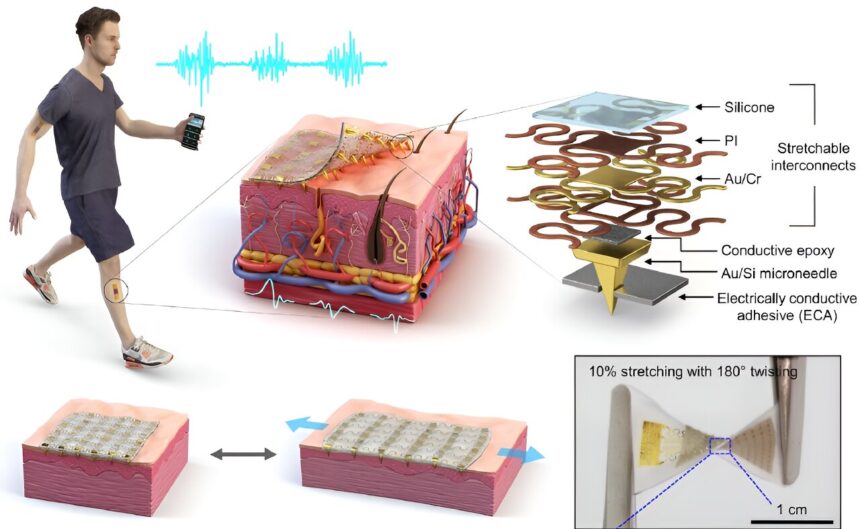
Design and working concept of the Stretchable microNeedle Adhesive Patch (SNAP). (A) Schematic illustration showing the overall system configuration and application of SNAP. (B) Exploded view schematic diagram of a SNAP, consisting of stretchable serpentine interconnects, Au-coated Si microneedle, and ECA made of Ag flakes–silicone composite. (C) Optical images showing high mechanical compliance of SNAP. Credit: The Korea Advanced Institute of Science and Technology (KAIST)

New electromyography (EMG) sensor technology that allows the long-term stable control of wearable robots and is not affected by the wearer’s sweat and dead skin has gained attention recently. Wearable robots are devices used across a variety of rehabilitation treatments for the elderly and patients recovering from stroke or trauma.

A joint research team led by Professor Jae-Woong Jung from the KAIST School of Electrical Engineering (EE) and Professor Jung Kim from the KAIST Department of Mechanical Engineering (ME) has successfully developed a stretchable and adhesive microneedle sensor that can electrically sense physiological signals at a high level without being affected by the state of the user’s skin.

The results of this research, written by co-first authors Heesoo Kim and Juhyun Lee, who are both Ph.D. candidates in the KAIST School of EE, were published in Science Advances under the title “Skin-preparation-free, stretchable microneedle adhesive patches for reliable electrophysiological sensing and exoskeleton robot control.”

For wearable robots to recognize the intentions behind human movement for their use in rehabilitation treatment, they require a wearable electrophysiological sensor that gives precise EMG measurements. However, existing sensors often show deteriorating signal quality over time and are greatly affected by the user’s skin conditions. Furthermore, the sensor’s higher mechanical hardness causes noise since the contact surface is unable to keep up with the deformation of the skin. These shortcomings limit the reliable, long-term control of wearable robots.

However, the recently developed technology is expected to allow long-term and high-quality EMG measurements as it uses a stretchable and adhesive conducting substrate integrated with microneedle arrays that can easily penetrate the stratum corneum without causing discomfort.

See also  EU enforces landmark Artificial Intelligence Act

Through its excellent performance, the sensor is anticipated to be able to stably control wearable robots over a long period of time regardless of the wearer’s changing skin conditions and without the need for a preparation step that removes sweat and dead cells from the surface of their skin.
Sweat-resistant wearable robot sensor
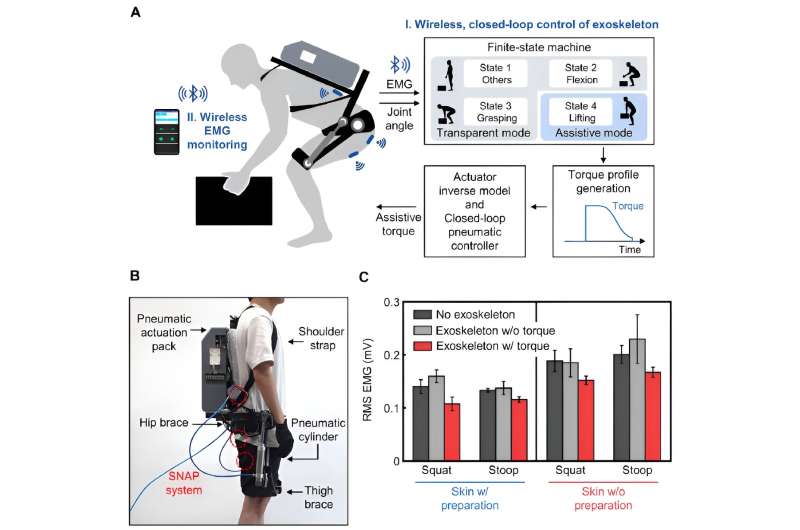
Demonstration of the wireless Stretchable microNeedle Adhesive Patch (SNAP) system as an Human-machine interfaces (HMI) for closed-loop control of an exoskeleton robot. (A) Illustration depicting the system architecture and control strategy of an exoskeleton robot. (B) The hardware configuration of the pneumatic back support exoskeleton system. (C) Comparison of root mean square (RMS) of electromyography (EMG) with and without robotic assistance of pretreated skin and non-pretreated skin. Credit: The Korea Advanced Institute of Science and Technology (KAIST)

The research team created a stretchable and adhesive microneedle sensor by integrating microneedles into a soft silicon polymer substrate. The hard microneedles penetrate through the stratum corneum, which has high electrical resistance.

The sensor can effectively lower contact resistance with the skin and obtain high-quality electrophysiological signals regardless of contamination. At the same time, the soft and adhesive conducting substrate can adapt to the skin’s surface and stretch with the wearer’s movement, providing a comfortable fit and minimizing noise caused by movement.

To verify the usability of the new patch, the research team conducted a motion assistance experiment using a wearable robot. They attached the microneedle patch to a user’s leg, where it could sense the electrical signals generated by the muscle. The sensor then sent the detected intention to a wearable robot, allowing the robot to help the wearer lift a heavy object more easily.

Professor Jae-Woong Jung, who led the research, said, “The developed stretchable and adhesive microneedle sensor can stability detect EMG signals without being affected by the state of a user’s skin. Through this, we will be able to control wearable robots with higher precision and stability, which will help the rehabilitation of patients who use robots.”

More information:
Heesoo Kim et al, Skin preparation–free, stretchable microneedle adhesive patches for reliable electrophysiological sensing and exoskeleton robot control, Science Advances (2024). DOI: 10.1126/sciadv.adk5260

See also  Oxford researchers call for enhanced AI ethics for children

Provided by
The Korea Advanced Institute of Science and Technology (KAIST)


Citation:
Research team develops sweat-resistant wearable robot sensor (2024, January 30)
retrieved 11 February 2024
from https://techxplore.com/news/2024-01-team-resistant-wearable-robot-sensor.html

This document is subject to copyright. Apart from any fair dealing for the purpose of private study or research, no
part may be reproduced without the written permission. The content is provided for information purposes only.



Source link

TAGGED: develops, Research, robot, sensor, sweatresistant, Team, wearable
Share This Article
Twitter Email Copy Link Print
Previous Article Acumera spreads edge computing across 2,600 US pizza and outlet stores via Casey’s pairing Acumera spreads edge computing across 2,600 US pizza and outlet stores via Casey’s pairing
Next Article CentralReach Acquires Silas CentralReach Acquires Silas
Leave a comment

Leave a Reply Cancel reply

Your email address will not be published. Required fields are marked *

Your Trusted Source for Accurate and Timely Updates!

Our commitment to accuracy, impartiality, and delivering breaking news as it happens has earned us the trust of a vast audience. Stay ahead with real-time updates on the latest events, trends.
FacebookLike
TwitterFollow
InstagramFollow
YoutubeSubscribe
LinkedInFollow
MediumFollow
- Advertisement -
Ad image

Popular Posts

OpenAI launches company knowledge in ChatGPT, letting you access your firm's data from Google Drive, Slack, GitHub

Is the Google Seek for inner enterprise information lastly right here...however from OpenAI? It definitely…

October 24, 2025

How to fix “The Archive PST cannot be found in Outlook 365”

In Outlook 365 and earlier variations, PST (.pst) recordsdata are used to retailer emails and…

September 5, 2025

SSE vs. SASE: Choosing the Best Cybersecurity Framework

The cybersecurity panorama continues to evolve, introducing new ideas and applied sciences that promise to…

December 29, 2024

Microsoft’s largest ever security transformation detailed in new report

Microsoft made safety its No. 1 precedence for each worker earlier this 12 months, following…

September 23, 2024

PAIX Data Centres To Build New Data Center in Dakar, Senegal

A brand new, cutting-edge knowledge heart is being in-built Dakar, Senegal, based on PAIX Information…

January 28, 2025

You Might Also Like

semiconductor manufacturing
Innovations

EU injects €623m to boost German semiconductor manufacturing

By saad
Marble enters the race to bring AI to tax work, armed with $9 million and a free research tool
AI

Marble enters the race to bring AI to tax work, armed with $9 million and a free research tool

By saad
NanoIC pilot line: Accelerating beyond-2nm chip innovation
Innovations

NanoIC pilot line: Accelerating beyond-2nm chip innovation

By saad
How biometrics secure our online world
Innovations

How biometrics secure our online world

By saad
Data Center News
Facebook Twitter Youtube Instagram Linkedin

About US

Data Center News: Stay informed on the pulse of data centers. Latest updates, tech trends, and industry insights—all in one place. Elevate your data infrastructure knowledge.

Top Categories
  • Global Market
  • Infrastructure
  • Innovations
  • Investments
Usefull Links
  • Home
  • Contact
  • Privacy Policy
  • Terms & Conditions

© 2024 – datacenternews.tech – All rights reserved

Welcome Back!

Sign in to your account

Lost your password?
We use cookies to ensure that we give you the best experience on our website. If you continue to use this site we will assume that you are happy with it.
You can revoke your consent any time using the Revoke consent button.