Building quantum computers mainly relies on building a stable network of qubits to store information, access it and perform computations. Yet the qubit platforms unveiled to date have a common problem: They tend to be delicate and vulnerable to outside disturbances. Even a stray photon can cause trouble. Developing fault-tolerant qubits — immune to external perturbations — could be the ultimate solution to this challenge.
A team led by scientists and engineers at the University of Washington has announced a significant advancement in this quest. In experiments with flakes of semiconductor materials, they detected signatures of “fractional quantum anomalous Hall” (FQAH) states.
Because FQAH states can support anyons, strange “quasiparticles” with only a small fraction of an electron’s charge, the team’s findings represent a first and encouraging step in constructing a specific form of fault-tolerant qubit. It is possible to create “topologically protected” qubits, which are stable against minor, local disruptions, using certain types of anyons.
Xiaodong Xu, the lead researcher behind these discoveries, said, “This establishes a new paradigm for studying quantum physics with fractional excitations in the future.”
The fractional quantum Hall state (FQAH state) is a rare phase of matter that exists in two-dimensional systems. Electrical conductivity is limited to precise fractions of the conductance quantum, a constant in these states. Fractional quantum Hall systems, however, frequently require strong magnetic fields to maintain their stability, rendering them unsuitable for use in quantum computing. Such a condition is unnecessary for the FQAH state, which is stable even “at zero magnetic fields.”
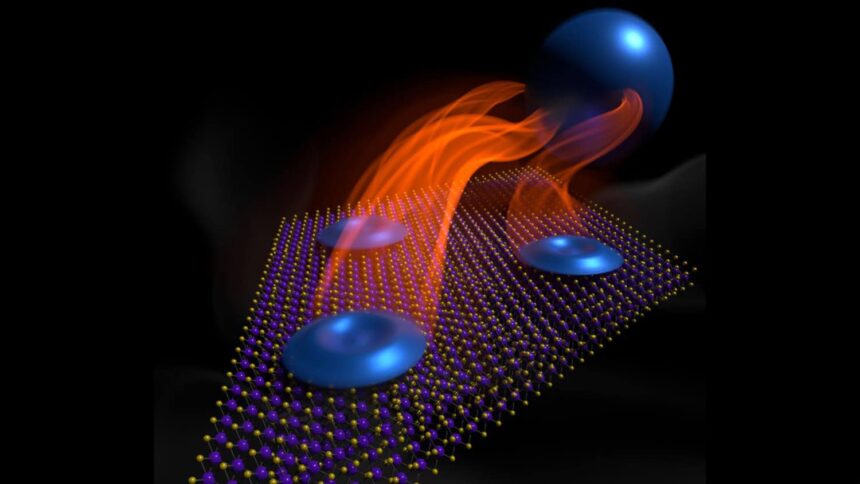
The scientists had to create an artificial lattice with exotic properties to host such an exotic phase of matter. They created a modest, mutual “twist” angle between two atomically thin flakes of the semiconductor material molybdenum ditelluride (MoTe2). This configuration created an artificial “honeycomb lattice” for the electrons.
The configuration developed an inherent magnetic when the configuration cooled the stacked slices to a few degrees above absolute zero. The strong magnetic field generally needed for the fractional quantum Hall state is replaced by intrinsic magnetism. The discovery of the FQAH effect signatures by the researchers using lasers as probes represents a significant advance in understanding anyons and their potential for quantum computing.
Scientists envision their system as a powerful platform for a deeper understanding of anyons, which have very different properties from everyday particles like electrons. Researchers aim to find “non-Abelian” anyons, which could be employed as topological qubits, an even more exotic variation of this quasiparticle in subsequent experiments with their experimental setup.
“Braiding” the non-Abelian anyons by encircling one another the fundamental building block of topological qubits, which represent a significant improvement over the capabilities of existing quantum computers, is the quantum state in which information is essentially “spread out” over the entire system and resilient to local disruptions.
UW physics doctoral student Eric Anderson said, “This type of topological qubit would fundamentally differ from those that can be created now. The strange behavior of non-Abelian anyons would make them much more robust as a quantum computing platform.”
Scientists’ experimental setup exhibits three fundamental properties simultaneously: Magnetism, Topology, and Interactions.
According to scientists, Their approach, non-Abelian anyons await discovery.
UW physics doctoral student Jiaqi Cai, co-lead author on the Nature paper and co-author of the Science paper, said, “The observed signatures of the fractional quantum anomalous Hall effect are inspiring. The fruitful quantum states in the system can be a laboratory-on-a-chip for discovering new physics in two dimensions and new devices for quantum applications.”
Xiaodong Xu, the lead researcher behind these discoveries, said, “Our work provides clear evidence of the long-sought FQAH states. We are currently working on electrical transport measurements, which could provide direct and unambiguous evidence of fractional excitations at zero magnetic fields.”
Journal Reference:
- Cai, J., Anderson, E., Wang, C. et al. Signatures of Fractional Quantum Anomalous Hall States in Twisted MoTe2. Nature (2023). DOI: 10.1038/s41586-023-06289-w